
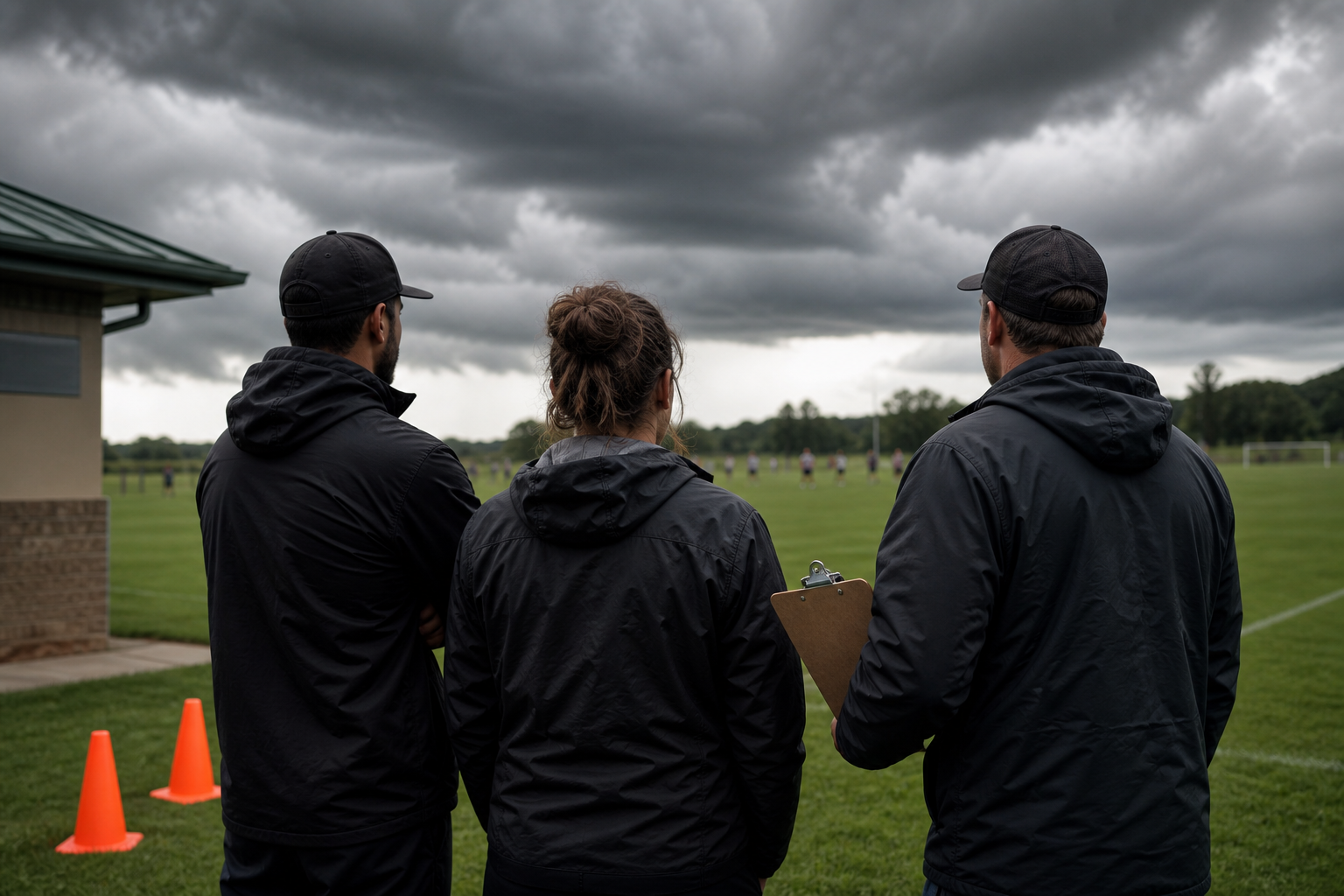
TL;DR: An outdoor sports lightning plan should name who watches conditions, where people go, how a pause is communicated, and who decides when activity can resume. The safest time to settle those details is before teams arrive—not when a storm is already close.
Direct answer
An outdoor sports lightning plan is a short, shared response plan: assign a weather monitor with authority to pause activity; identify safe shelter and routes; state how participants, families, and officials will be notified; and use the National Weather Service’s guidance to wait at least 30 minutes after the last thunder before resuming outdoor activity. It should complement, not replace, the host organization’s local emergency procedures.
Why a plan needs more than a weather app
A forecast can help an organizer prepare, but a forecast is not a communication plan. At a field complex, one person may see a warning while another is setting up equipment, a team may be warming up away from the main entrance, and families may be parked across a large lot. The practical question is not only “Is rain coming?” It is “Who can pause play, where does everyone go, and how will they know?”
The U.S. National Weather Service (NWS) advises groups to make a lightning safety plan before outdoor activities begin. Its outdoor-sports guidance emphasizes a designated weather watcher and a timely move to a safe place when thunder is heard. This article uses that U.S. federal guidance; venue rules, municipal procedures, and event policies may add requirements.
The CLEAR field-plan framework
Use CLEAR to turn a vague “weather policy” into something an event crew can use:
- C — Call the monitor. Name one primary weather monitor and a backup. Make clear who can call a pause; a group decision made in a rush is often a delayed decision.
- L — Locate safe shelter. Confirm the actual safe buildings or fully enclosed hard-topped vehicles available at the venue. Do not assume a tent, dugout, open shelter, or nearby tree is a safe substitute.
- E — Explain the signal. Decide how a pause reaches every area: venue announcement, a designated staff relay, team contacts, or the event’s established communications channel. Keep the wording short and repeatable.
- A — Assign movement and accountability. Decide who directs teams from warm-up areas, who checks common gathering points, and where questions go. Keep the plan focused on getting people to safety rather than trying to solve the rest of the schedule at the same time.
- R — Resume deliberately. NWS guidance says to wait at least 30 minutes after the last thunder before returning outdoors. State who records the last thunder and who communicates the restart or cancellation decision.
Make the pause message usable under pressure
A good pause message should be plain enough to repeat without interpretation. For example: “Outdoor activity is paused. Move now to the designated safe shelter or a fully enclosed hard-topped vehicle. Wait for the event update before returning.” The organization should adapt the wording and channels to its own venue policy.
Separate the immediate safety instruction from the schedule update. Families first need to know where to go and whether they should remain there. Bracket changes, field assignments, and restart times can follow once the event lead has reliable information. That sequencing reduces the temptation to crowd one contact person with questions while movement is still underway.
Test the plan before the first whistle
A five-minute pre-event check is more useful than a long document no one has read. Walk the crew through these questions:
- Who is monitoring weather, and who covers if that person is unavailable?
- What exact places count as safe shelter at this venue?
- How will a pause reach a field, court, parking area, and concession area?
- Who has authority to stop activity and to announce a return?
- What is the organization’s approved channel for schedule changes after the immediate safety message?
If an answer is unclear, fix the operational gap before the event begins. A plan should be visible to the people expected to use it, not just stored in an organizer’s inbox.
Where OVR fits
For organizations using OVR’s event and team tools, the same connected event record can carry schedules, venue information, teams, and public event pages. That gives organizers a place to keep approved event information aligned as conditions change. OVR does not replace local emergency procedures or the judgment of event officials; the goal is to make the information participants need easier to find after the organization has made its decision.
Related reading
- Event Microsite Checklist Before a Schedule Goes Live
- What a Tournament Microsite Needs Before Families Arrive
- How a Tournament Schedule Change Should Reach Every Team Record
Frequently asked questions
Who should be allowed to pause an outdoor sports event for lightning?
The event organization should designate a weather monitor and a backup before play begins, with clear authority to trigger the organization’s approved pause procedure.
Is a tent or open dugout safe during lightning?
No. The NWS identifies a substantial building or a fully enclosed metal-topped vehicle as safer options; an open shelter is not a substitute.
How long should outdoor activity stay paused after thunder?
The NWS recommends waiting at least 30 minutes after the last thunder before resuming outdoor activities. Hosts should also follow any stricter local or venue rule.
Should organizers announce a restart time as soon as play stops?
Not necessarily. First communicate the pause and shelter direction. Share a restart, delay, or cancellation update only once the event lead has reliable information and has followed the organization’s procedure.
Can one event page help with weather-related updates?
It can help organizers publish approved schedule and venue information in one predictable location, but it is not a replacement for the safety plan, local procedures, or on-site instructions.
Sources
- U.S. National Weather Service, “Lightning Safety and Outdoor Sports Activities” — U.S. federal public-safety guidance; accessed August 20, 2026. Guidance is general and must be used alongside venue and local emergency procedures.
- U.S. National Weather Service, “Lightning Safety Outdoors” — U.S. federal public-safety guidance; accessed August 20, 2026. Includes shelter and 30-minute return-to-activity guidance.
Key takeaways
- Assign a weather monitor and backup before outdoor activity starts.
- Identify safe shelter and a simple route for every part of the venue.
- Send the shelter instruction before attempting to solve the schedule.
- Use a clear, pre-approved authority and communication path for pauses and returns.
- Follow NWS guidance and the host organization’s local procedures when deciding when activity can resume.