
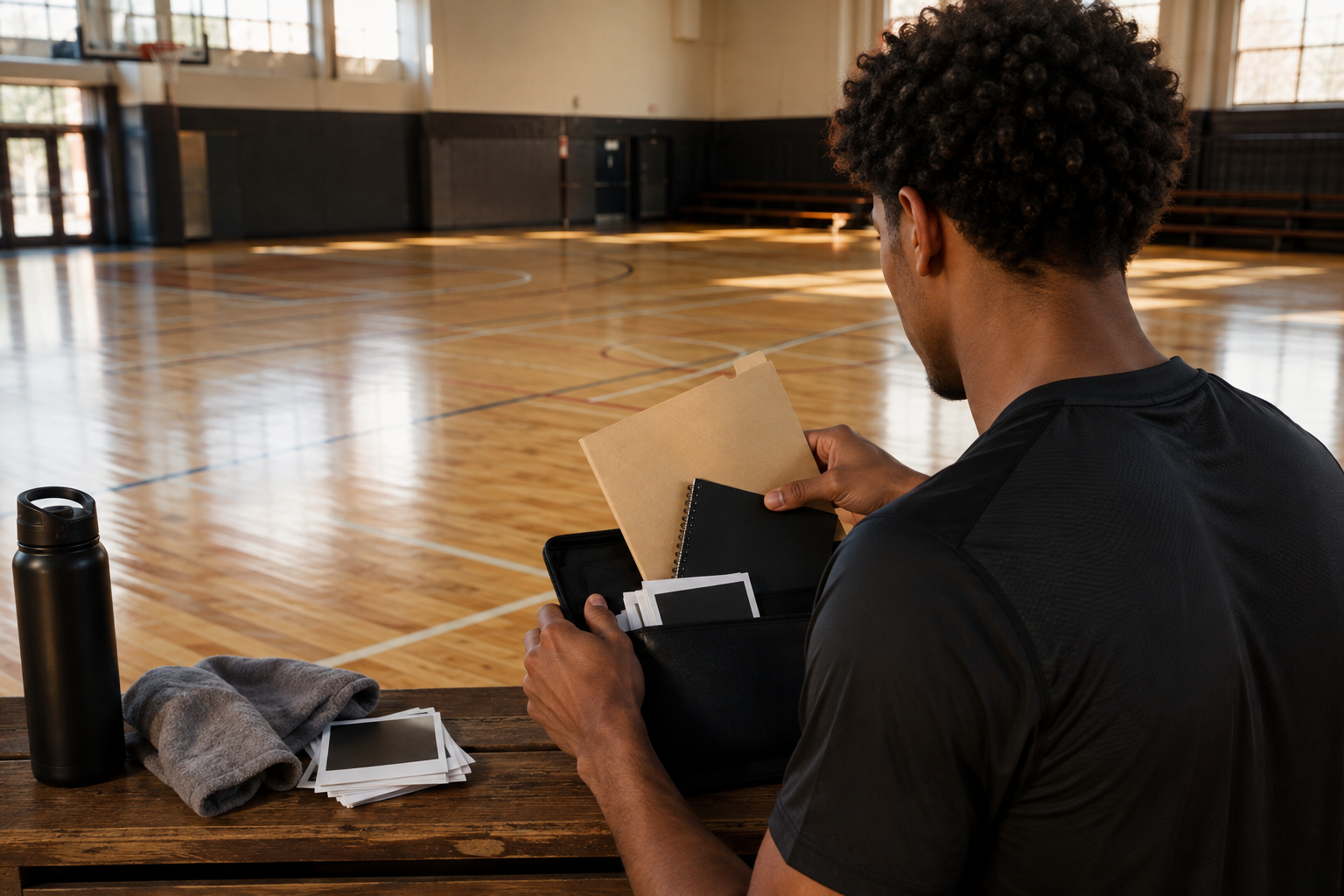
How to Make a Personal Sports Reference Folder Before a New Season
TL;DR
A personal sports reference folder is a small, private collection of the notes, moments, and practical details an athlete wants to carry into a new season. Keep it selective: it should make the next first practice easier, not become a public scorecard or a dump of everything from last year.
Direct answer
Make one folder with five short sections: your routine, useful reminders, selected season moments, questions for the next phase, and a simple archive. Use dates and plain labels so you can find what matters later. The goal is personal context—not a ranking, an official record, or something you have to share.
Why a small folder beats a giant camera roll
Most seasons leave behind more material than anyone can use: photos, clips, group messages, schedules, screenshots, scores, and half-finished notes. The problem is not that any one item is unimportant. It is that a pile of unlabelled files asks you to remember everything at once.
The Library of Congress’s personal digital-archiving guidance recommends adding descriptions to digital photos and using consistent file names. Its scanning guidance gives a practical example: begin a file name with year and month, then add a short description so files sort chronologically. That is preservation advice, not a sports-development study, but it is a helpful rule for keeping a personal season record findable.
A reference folder is deliberately smaller than an archive. An archive keeps material. A reference folder answers: what would I want to remember when the next season begins?
The Five-Section Reference Folder
1. My routine
Write down the ordinary things that helped you arrive ready: what you packed, how early you liked to leave, a warm-up cue you wanted to remember, or the kind of note that settled you before practice. Keep this in your own words. It is not a prescription for anyone else.
2. Useful reminders
Save a few specific reminders that were useful during the season. They might be a technique cue you want to ask about again, a phrase that helped you reset after a mistake, or a practical lesson about rest, preparation, or communication. A reminder is useful because it is attached to a real situation, not because it sounds impressive.
3. Selected season moments
Choose three to five moments, not fifty. A moment can be a photo, a short clip, a schedule, a jersey number, a game note, or a sentence about something you learned. Add one line of context: the date, the event, and why you kept it. This keeps a memory from becoming an unexplained file.
4. Questions for the next phase
End with questions instead of verdicts. For example: “What part of my warm-up do I want to repeat?” “What skill do I want more help understanding?” “What made competition feel fun?” Questions make room for the next season to be different.
5. The archive link
Put everything else in one clearly named archive folder, such as 2026-08-summer-season-archive. You do not need to curate it perfectly today. You only need a reliable place for material that is worth keeping but does not belong in your quick-reference view.
A 20-minute setup that stays manageable
- Start with one season. Do not try to repair every old folder at once.
- Create the five sections. A notebook, cloud folder, or local folder can work; choose the format you will actually reopen.
- Pick three to five moments. Choose items with a reason, not just the most polished images.
- Add a date and a plain label. Use a format such as
2026-06-tournament-arrival-note. - Write two next-season questions. Keep them curious and controllable rather than turning them into a grade.
- Stop. A small folder you can use is better than an ambitious system you abandon.
Keep the folder yours
A personal reference folder does not have to be public, polished, or complete. Avoid adding sensitive personal details, contact information, or anything that belongs only in a team, family, medical, or school record. If a photo or clip includes other people, consider whether you have a good reason to retain or share it before moving it beyond your private collection.
That boundary also helps with the emotional side of a season. A reference folder can hold a hard game, but it does not need to turn that game into your identity. It can hold a win, but it does not need to make the win a verdict. The useful question is simply: will this help me remember, prepare, or ask a better question later?
Use reflection without turning it into pressure
The Aspen Institute’s Project Play coach guidance encourages reflection rituals around practices and games, including discussion of the skills being prioritized and the idea that mistakes are part of learning. It is guidance for adults leading youth sport, not proof that a folder changes performance. Still, it supports a modest approach: capture a lesson, name a question, and leave space to learn more.
Try this closing note: One thing I want to carry forward is ____. One thing I want to understand better is ____. That is enough. You are building continuity, not a case for being “good” or “bad” at sport.
Related reading
- What Makes a Season Record Useful After the Final Game?
- How to Keep a Practice Notebook That Helps You Remember What You’re Learning
- How to Keep a Personal Sports Photo Archive That Still Feels Like Yours
Sources
- Library of Congress, “Personal Digital Archiving: The Basics of Scanning” (United States, 2014). General personal-archiving guidance; its filename example informs the organization method here and is not sport-specific evidence.
- Library of Congress, Personal Digital Archiving Day Kit (United States, accessed September 2026). Describes guidance on preserving personal digital files, photos, videos, and adding descriptions; not a youth-sports outcome study.
- Aspen Institute Project Play, “Calls for Coaches” (United States, accessed September 2026). Practical youth-sport culture guidance on reflection; it does not establish that this folder improves performance or retention.
Frequently asked questions
Should a personal sports reference folder be public?
No. It can stay entirely private. The purpose is to help the athlete remember and prepare, not to create a public profile or prove anything to other people.
What should go in the folder?
Start with a routine note, a few useful reminders, three to five selected moments, two next-season questions, and a link to the fuller archive.
How is this different from a photo archive?
An archive keeps more of the material from a season. A reference folder is the small set of items you want to reopen quickly when a new season begins.
Do stats belong in a personal reference folder?
They can, if they have context and are useful to the athlete. A private note is not an official record, a ranking, or a reason to compare yourself with someone else.
How often should I update it?
A short check at the end of a season is enough for most people. Update it again only when something genuinely useful would otherwise be hard to find.
Key takeaways
- Make a small private reference folder instead of trying to curate every file from a season.
- Use five sections: routine, reminders, selected moments, next-phase questions, and archive.
- Date and plainly label files so the context is easier to find later.
- Keep reflection curious and specific; do not turn a season into a grade or ranking.
- Protect personal boundaries by keeping sensitive details out of a general reference folder.